
A Living Artistic Thread through the 20th Century
Patti Smith is that. Plus a pioneer, poet, punk, widow, mom...

Here in Chicago, I live 3 blocks from one of the most important music schools in the country. The Old Town School of Folk Music (no longer in Old Town) gives classes to almost 5,000 people a week. It’s situated in a former public library, still decorated by ‘30s style murals and architectural artifacts.
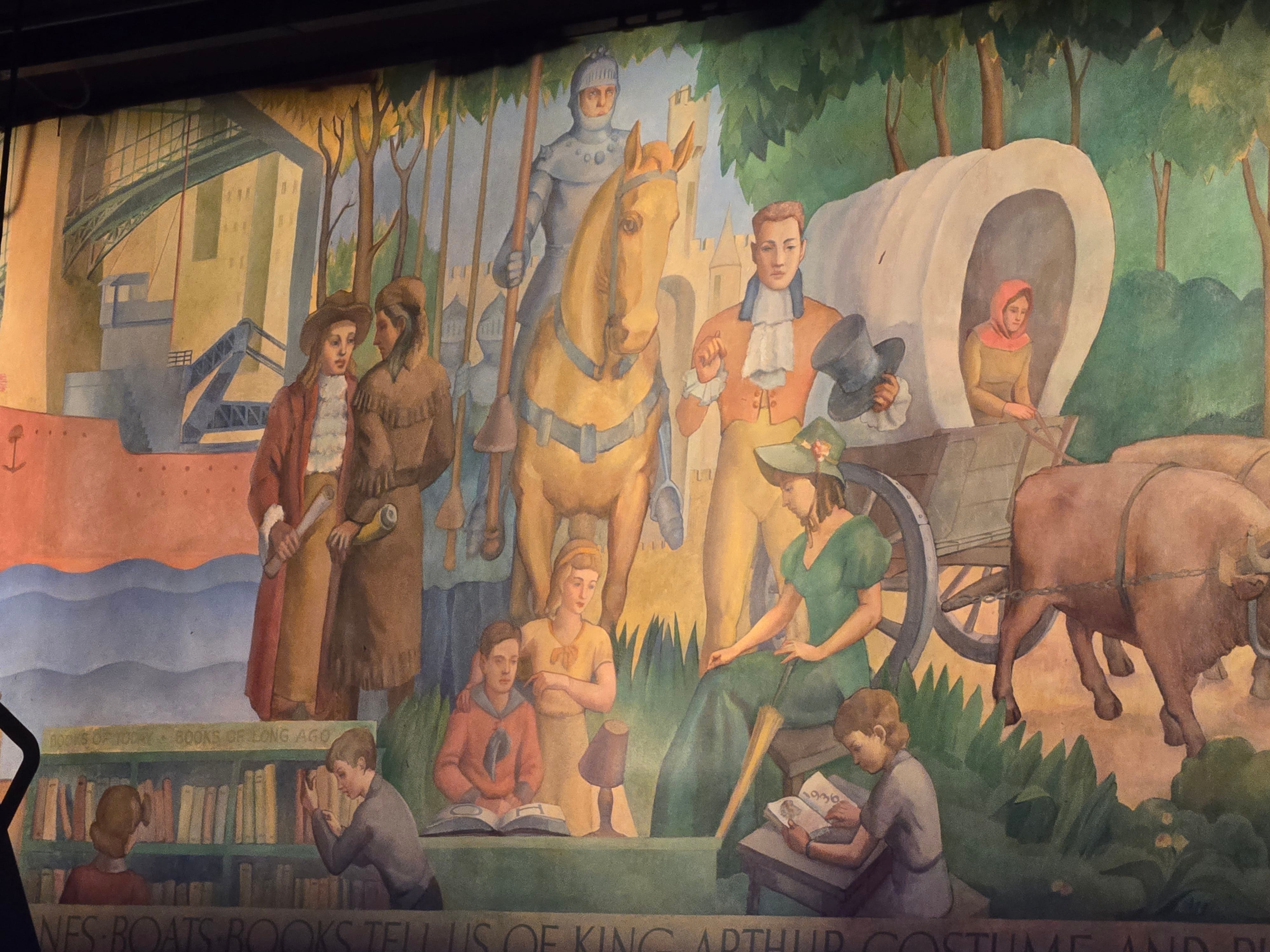
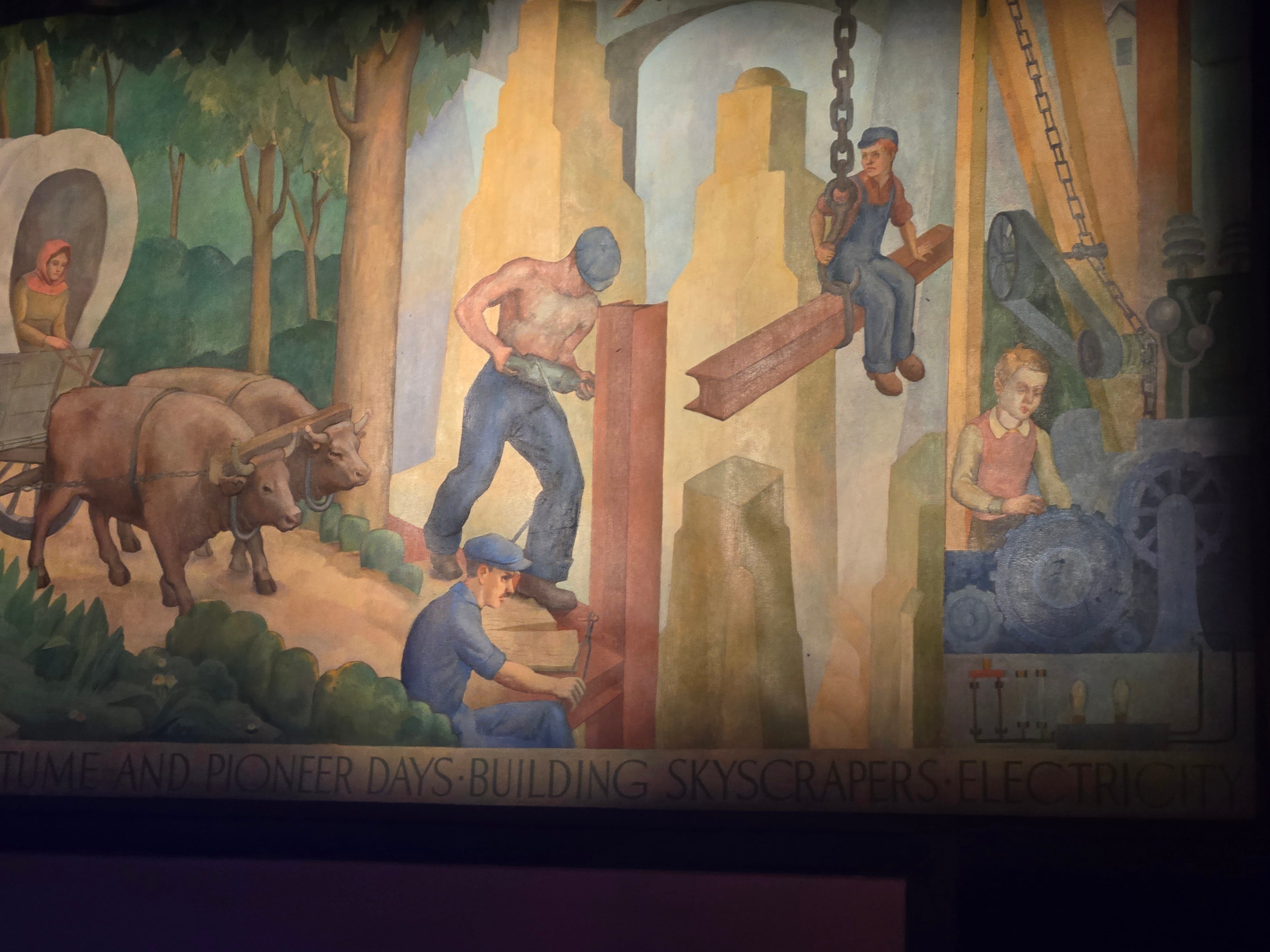
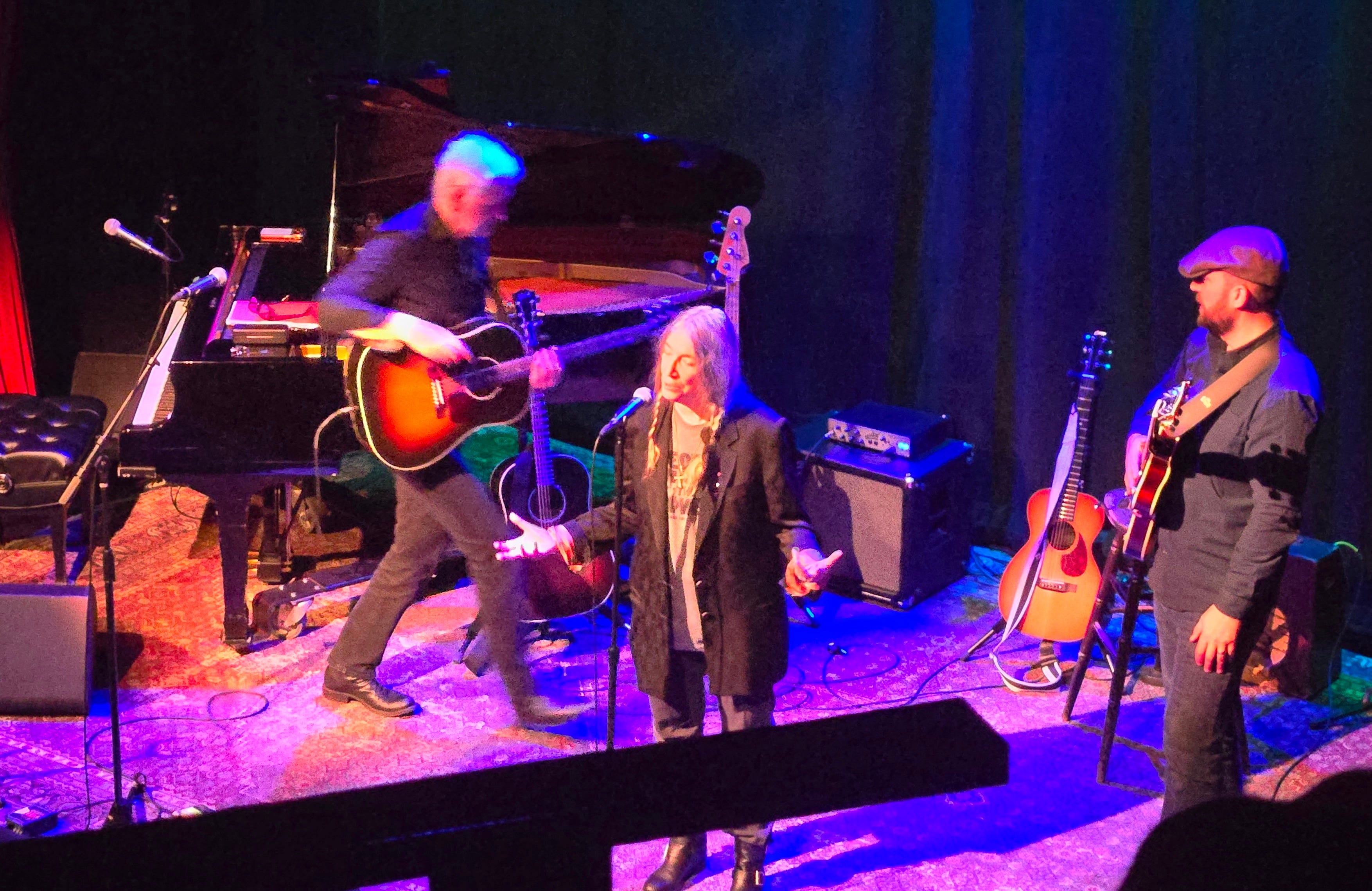
This is fitting because we saw Patti Smith perform there last night, where her presence represented a crucial thread in the line of 20th and 21st century artistic heritage. A living repository of knowledge and inspiration.
This is an observation she would immediately brush off, of course. She remains funny and a little humble, though I think she is aware of her status. Or maybe it’s just her absolute faith in the importance of poetry, performance and resistance that doesn’t allow her to discard that just out of false modesty.
(One of her funniest asides of the evening was a story about performing with Bob Dylan after her husband Fred died of cancer in 1994. Dylan had brought her on tour on the advice of Allen Ginsburg, and gave her his song book to choose a song they might sing together. While she paged through it in her dressing room, she sang “Like a Rolling Stone” into her mirror, “a song I could sing better than him any night.” When they met onstage, she wrote, “As we shared the microphone, and I saw the beads of sweat on his forehead, I thought, ‘Here I was, just a widow, singing with the poet who made my young knees buckle, and he’s just a man’.” I’m not directly quoting, but it’s somewhere in M Train.)
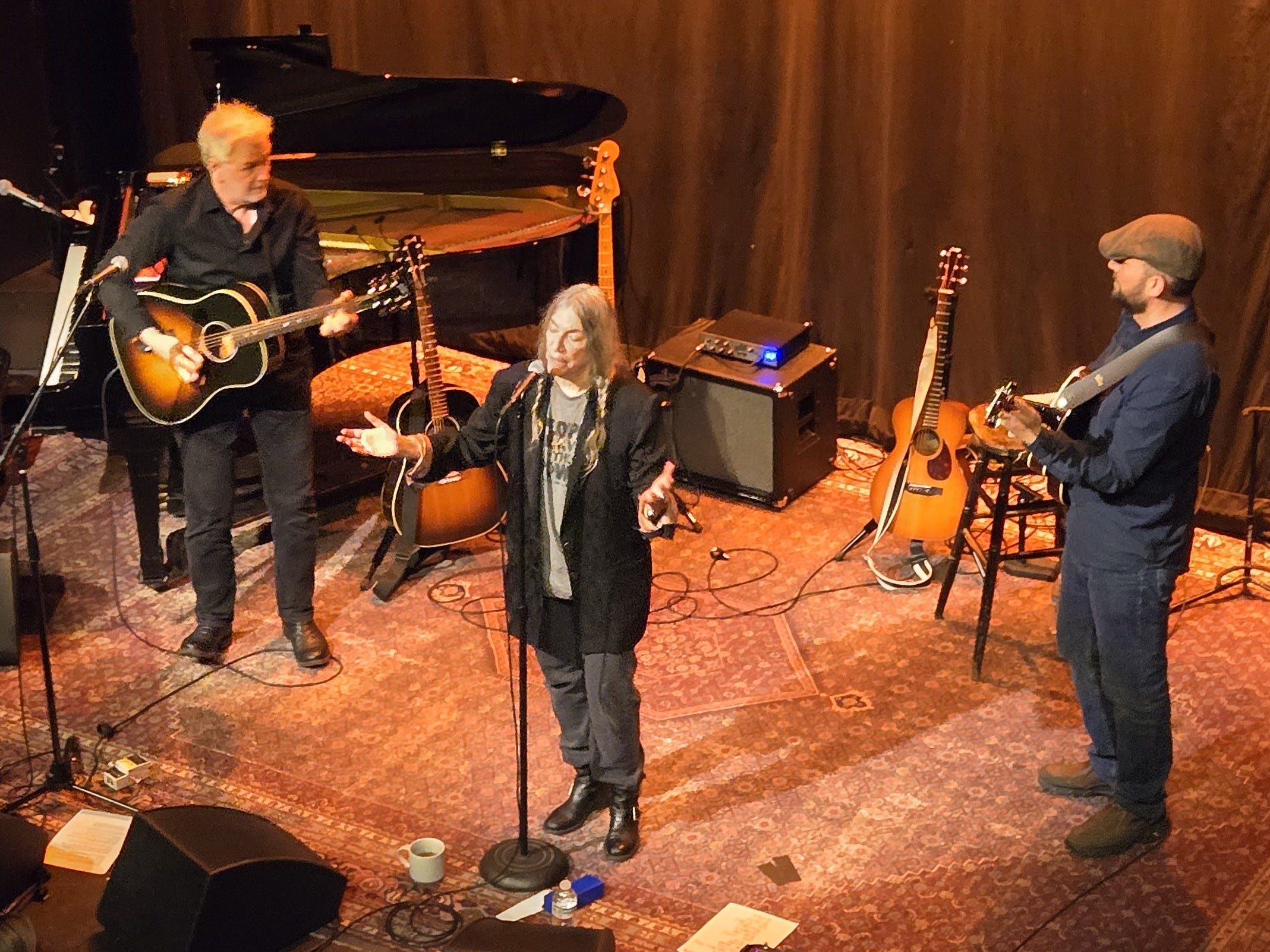
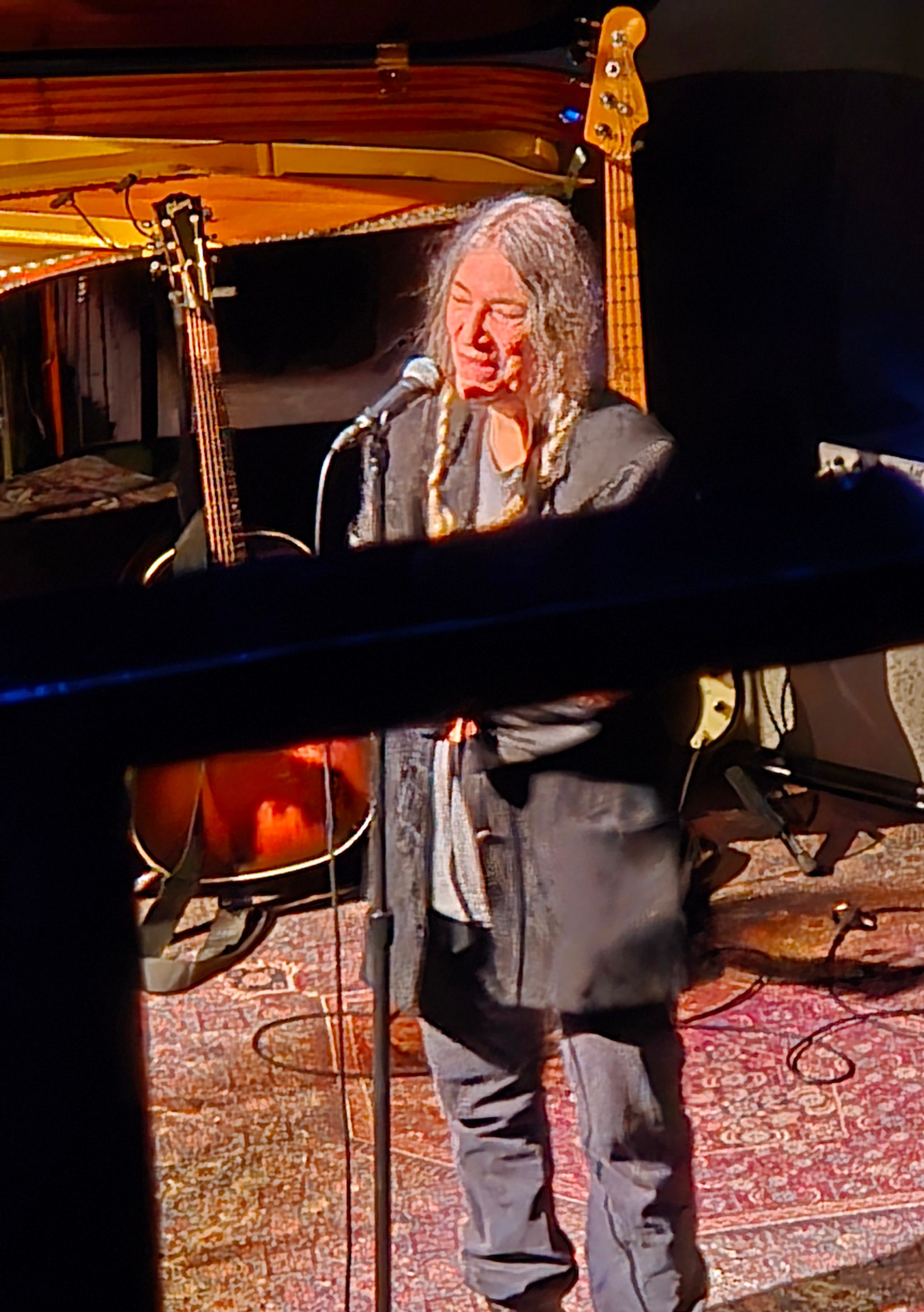
Last night’s was a modest show. Along with her son Jackson Smith and multi-instrumentalist John Shanahan, Patti sang 7-8 songs and read passages from M Train. Her stage presence was amazing, and all us old folks (a much older crowd than the Mavis Staples concert I wrote about in January, and pretty folky) gobbled her up like we were starved for her attention. Her insights aren’t huge or groundbreaking — she talks of the importance of work, family, friends, joy, hope and openness in her calm, even voice.
Patti Smith is a woman in full.
That’s the phrase that hit me walking home: A woman in full. (A play on the title of a Tom Wolfe novel I never read.) She has been a daughter, a sister, a poet, a pioneer, a punk rocker, a vagabond, a wife, a mother, a widow, a survivor. And all of us last night found a soothing light in those aspects of her life. She carries them like merit badges. She is alive in all of them. And through the example of Patti Smith, all the twists and turns of our own lives become less like diversions and setbacks, and more like the bricks and mortar of a celebratory life. A life rich with blessings, whether we think about it or not.
(I have a greater appreciation for Patti after reading Please Kill Me: The Uncensored Oral History of Punk. She was one of the machers of the early punk scene in NYC, of course. After she brought poetry to the nightclub stage, then merged it with music, others could only follow in her wake. She was not averse to using her sex appeal to get what she wanted from people [so say the interviewees]. And she once crashed an audition session by Blondie and tried to steal Clem Burke for her own band! What a hilarious idea! Debbie Harry told her in no uncertain terms to pound sand.)
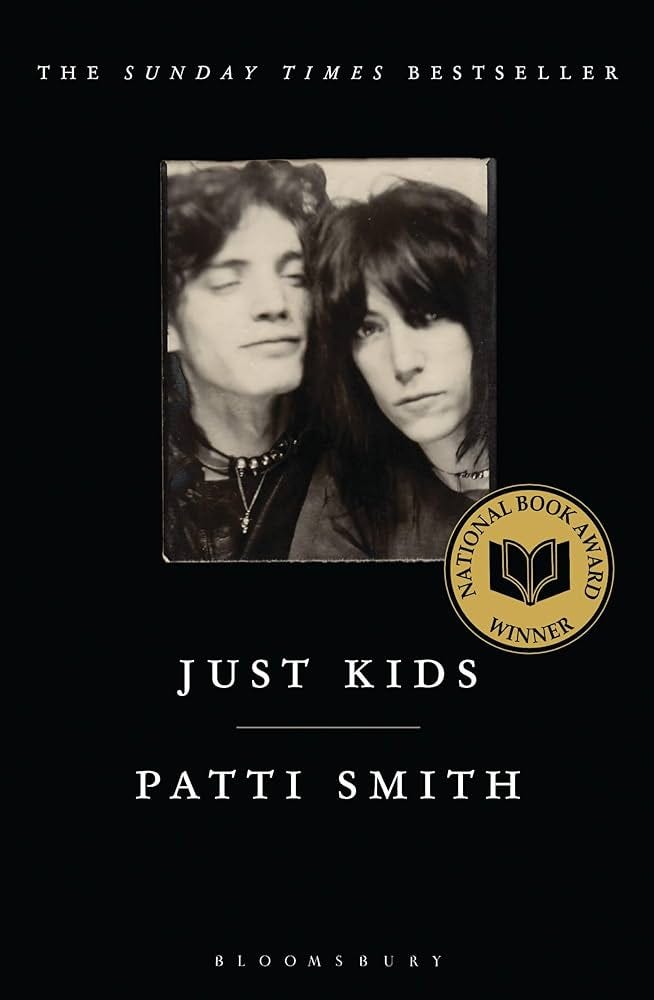
Until the publication of Just Kids some 16 years ago, Patti Smith had receded for me into the haze of my new wave and college years. Her albums were monuments back then. We played them over and over, but I didn’t need to hear her “Gloria” often, with her Lene Lovich-style vocals. We all have a moment in the spotlight etc. etc.
But in Just Kids, Patti made the poor artistic life of the Lower East Side NYC sound like Neverland. Her casual asides about Baudelaire and Mapplethorpe and Ginsburg and the rest sounded like throwaway lines, but they formed the outline of an artist dedicated to her inspirations and her work. Not self-serious, but strong and resolute in what she feels is the truth. And the Truth. And it was a book none of us knew we needed. (A friend once described On The Road as a story in which every bit of a hitchhiking trip went right. That’s what Just Kids felt like.)
Since then, she has written M Train and Year of the Monkey and A Book of Days and Bread of Angels, all terrific. She’s toured the world again and again, soaking in the love of a small but dedicated fanbase. She’s started a Substack that shares her joys and quotidian thoughts, often from her small and sparse Far Rockaway bungalow. And as she enters her 79th year, she radiates a simple joy that we’ve all at times felt when we see a painting, read a poem or sip a coffee that thrills us to the marrow. Last night, she told a story about William Blake (of course) dying in poverty but still working on illustrations for The Inferno. “The work. He kept doing the work.”
And that’s what it has come down to for her. The connections and the work. She lives it every day.
When Patti told a childhood story about standing up to the neighborhood bully to protect her younger brother Toddy, I had a flashback to my own youth, when bullies seemed to be everywhere and might made right. Her backstory of rough living paints vivid pictures of postwar New Jersey, I can picture the streets and vacant lots, the quonset huts and deposit pop bottles. Her childhood illnesses and her salvation by books is one repeated by many, many artists through time. And then her pilgrimage to Manhattan in 1972, like Alice in Wonderland.
When you consider, Patti Smith is a throughline from Baudelaire and the post-Romantic writers of the mid-19th century, to the American folk singers of the Depression, the Beats of the Eisenhower years, the punks and poets of the 1970s, all the way through ‘til today. She wears this heritage as simply as she does her plain black jacket.
And all because she follows what inspires her. It seems so easy — she makes it look so easy — but it can be so hard if you aren’t patient with yourself.
She left us singing “People Have the Power” and exited with no encore. She had another show to do in 30 minutes! But without belaboring the current state of the nation, she encouraged us to “stick together” until we get to the other side.
She didn’t have to say it twice. We gobbled up every word.
If you'd like to see a nice limerick about Patti in an Atlanta Braves jacket, please visit Bardball.com
Or sign up for my other Substack for Bardball, which sends out the week's baseball poetry every Saturday morning.
Made me wish I was there!